
Knowledge in education
See below under Feature Articles for HISTORY, ENGLISH AND SCIENCE Submissions to the Government
KNOWLEDGE-RICH EDUCATION
A knowledge-rich curriculum has 7 features:
(1) Disciplinary-derived and accountable knowledge.
(2) Subject-defined concepts and content.
(3) Epistemological coherence.
(4) Logical progression.
(5) Appropriate balance of explicit teacher instruction and related student activities.
(6) Curriculum content connected to students' understanding informed by cognitive science principles and appropriate teaching methods.
(7) A Purpose Statement justifying these features as the means for individual achievement and society's benefit.
Since the 1970s New Zealand's curriculum knowledge has been progressively diluted. My research has identified the causes and effects of the damage in The Politics of Knowledge in Education published in 2012. The book provides an analysis of the causes of New Zealand’s educational decline and proposes a curriculum based on rich subject knowledge. In the subsequent decade I developed the Curriculum Design Coherence Model. Working with colleagues in the Knowledge in Education Research Unit (KERU), the CDC Model was trialled in the Knowledge-Rich School Project. The results were published in the international journal, Review of Education in 2021.
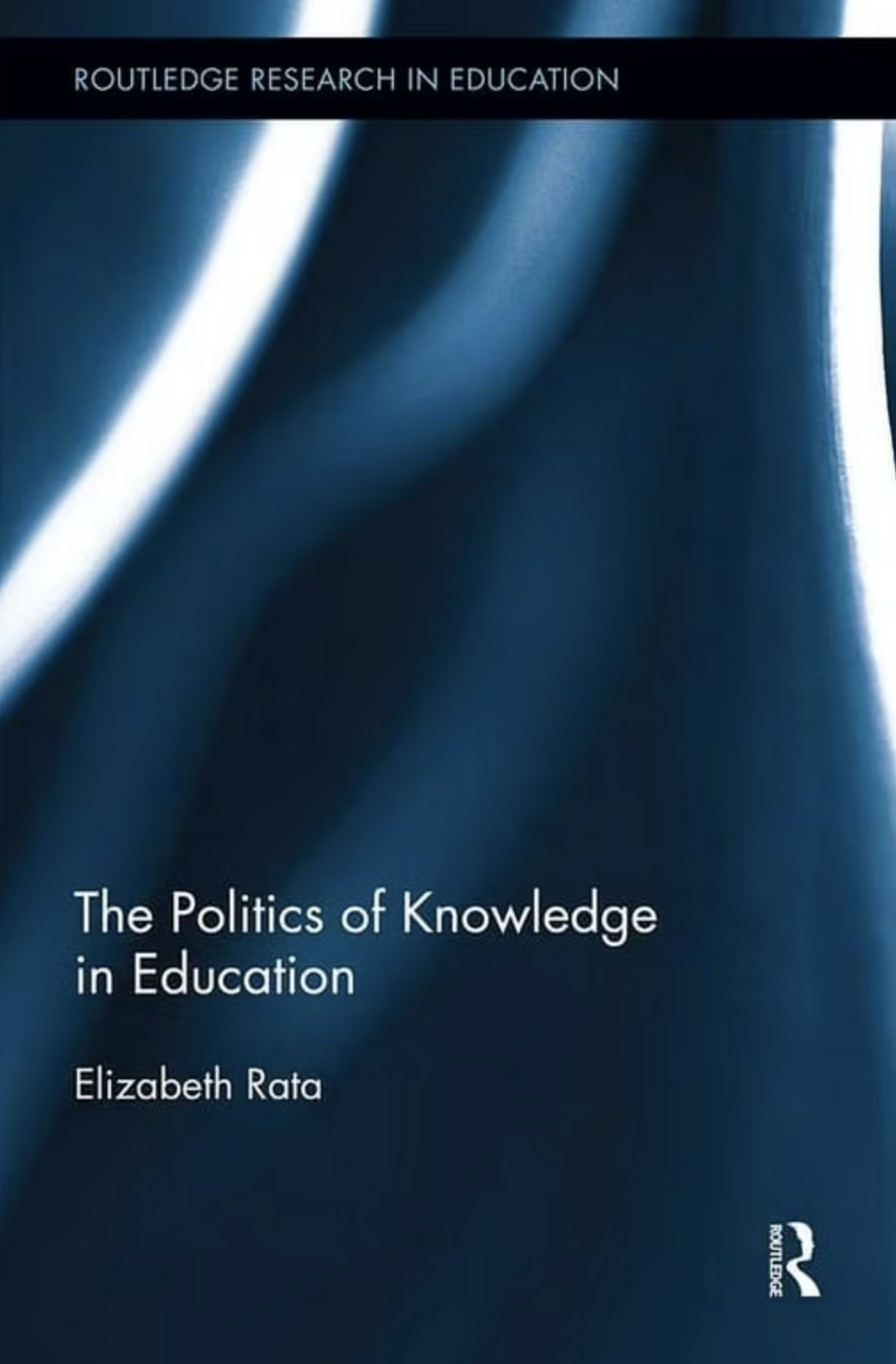
The Politics of Knowledge in Education, Elizabeth Rata (2012)
Featured Articles
Submission on the Draft Social Sciences Curriculum
My submission on the Draft Social Sciences Curriculum explains why the Draft is 'knowledge-rich'. I note only a few instances where treatyist, marxist critical theory and decolonising ideologies intrude and recommend their removal. On the whole this is an excellent document. I congratulate the writers.
ENGLISH
"The opinion has even been voiced that school instruction in grammar could be dispensed with . . . our analysis clearly showed the study of grammar to be of paramount importance for the mental development of the child." (Vygotsky, 1934)
My submission on the Draft English Curriculum 0-10 was sent to the Ministry of Education in May 2025. The final English curriculum was released in October 2025. Although it does not go as far as my submission in requiring prescribed titles, the final document is excellent in terms of design and content. It is certainly knowledge-rich.
SCIENCE
Dr Nick Matzke is a biologist at the University of Auckland. He has given me permission to post his 'Submission on the Draft Science Standards' on my website. It is well worth reading.
First, he successfully refutes the four claims made by those parts of the educational establishment seeking to delay or demolish the current (2023-2026) government's efforts to finish the Curriculum refresh. He makes specific mention of the Aotearoa Educators Collective.
Second, he describes what is the Draft Science Standards' major strength – it covers the basic content knowledge students need to know actual science knowledge pointing out "that sciences like biology, chemistry, and physics have a substantial body of core concepts and theory which are absolutely necessary to becoming conversant in these disciplines. Only a portion of this can be successfully taught before secondary school/high school, but the early years should at least build strong familiarity with basics (such as planets, orbits, and gravity in physics; atoms and molecules in chemistry; and genetic inheritance and evolution in biology)". These basics are in the Draft Science Standards.
Dr Matzke told me in a personal communication that there are some reasonable criticisms of the draft science standards but that they are minor. The main one is that "the choice of scientists to highlight is rather random and not particularly necessary especially at the younger ages – putting the ancient Greek botanist Theophrastus in Year 1". He said that "If he were to do famous scientists for Y1-10" he "might start with e.g. Erathosthenes who showed that the Earth is round, and even measured the circumference pretty well, using shadows at different places in Egypt, and trigonometry etc. But that would be more like Year 4 or 5 or 6. It's a useful topic to show (a) how far you can get with simple tools, (b) that people knew the Earth was round long before Columbus in 1492, (c) illustrate the uses of angles, circles, etc. Beyond that, it's probably worth mentioning the super-duper-famous scientists that should be part of general public knowledge – Galileo, Newton, Darwin/Wallace, Watson/Crick/Franklin for DNA – and some NZ/Pacific figures for local interest/inspiration. So I'd keep those ones, for the later years."
His comments reminded me that during my Knowledge-Rich School Project (2018-2022) which included working with science teachers to design lessons, I was struck by how elastic the subject had become; how emptied out it was of actual science content. This was the result of decades of education characterised by the localised curriculum, student-led approaches, and decolonising politics. Instead of being taught science content, students were working on the fringes of science – on the history of science (famous scientists but not their science); science ethics and policy (often falling into activism, especially over the climate); technology (a focus on its harm not the benefits); traditional beliefs and practices (falsely presented as equivalent to modern science).
The Draft Science Standards will get the science curriculum back on track. Once again New Zealand children will be guaranteed the "line of study which has for its object the imparting of the fundamental laws which regulate the phenomena of the world in which we live" – a quotation from an 1879 newspaper item about the modern science being introduced into New Zealand schools in the late 19th century – a subject no doubt of value to those such as the boy, Ernest Rutherford at Foxhill School, then Havelock School in the 1880s.
Dr Matzke's submission provides a significant acknowledgement of the proposed curriculum's quality.
I encourage you to read it.
A Knowledge Rich Curriculum for New Zealand
For an overview of recent work, please read my article on the Open Inquiry website.
Read here
Developing Curriculum for Deep Thinking
Contains the latest research about the knowledge-rich curriculum and the science of learning.
Read here
Other Publications:
Rata, E. (2021). The Curriculum Design Coherence Model in the Knowledge-Rich School Project. Review of Education. DOI: 10.1002/rev3.3254
Read here
Rata, E. (2021) Context and Implications Document for The Curriculum Design Coherence Model in the Knowledge-Rich School Project. Review of Education. DOI: 10.1002/rev3.3253
Read here
Rata, E. (2021)What is a Knowledge-Rich Curriculum? New Zealand Annual Review of Education. https://doi.org/10.26686/nzaroe.v26.6855
Read here
Rata E., McPhail G. (2020) Teacher Professional Development, the Knowledge-Rich School Project and the Curriculum Design Coherence Model. In: Fox J., Alexander C., Aspland T. (eds) Teacher Education in Globalised Times. Springer, Singapore
Read here
Rata, E. (2019). Knowledge-Rich Teaching: A Model of Curriculum Design Coherence, British Educational Research Journal. Vol. 45 Issue 4, p681-697. DOI:10.1002/berj.3520
Read here
McPhail, G., & Rata, E. The Knowledge Democracy Connection and Music Education, Philosophy of Music Education Review, 27 (2), 112-132.
Read here
Rata, E. (2018) Knowledge and politics, Educational Philosophy and Theory, 50:14, 1318-1319, DOI:10.1080/00131857.2018.1461363.
Read here
Rata, E. (2017). Knowledge and Teaching, British Educational Research Journal. 43(5), 1003-1017. DOI:10.1002/berj.3301
Read here
Rata, E. (2016). A pedagogy of conceptual progression and the case for academic knowledge. British Educational Research Journal, 42 (1), 168-184. 10.1002/berj.3195;
Read here
Rata, E, McPhail, G, & Barrett, B. (2019). An Engaging Pedagogy for an Academic Curriculum. The Curriculum Journal, 30(2), 162-180.
Read here
Rata, E. and Taylor, A. (2015). Knowledge equivalence discourse in New Zealand secondary school science. New Zealand Journal of Educational Research. 50(2), 223-238. DOI 10.1007/s40841-015-0020-1
Read here
McPhail, G. & Rata, E. (2017). A theoretical model of curriculum design: ‘Powerful Knowledge’ and ‘21st Century Learning’. In. B. Barrett, U. Hoadley & J. Morgan (Eds.) Knowledge, curriculum and equity: Social realist perspectives. Routledge publisher. Ch 6.
Read here
McPhail, G. & Rata, E. (2015). Comparing Curriculum Types: ‘Powerful Knowledge’ and ’21st Century Learning’ New Zealand Journal of Educational Research, 51(1), 53-68.
Read here
Rata, E. (2012) The Politics of Knowledge in Education. British Educational Research Journal, 38(1), 103-124.
Read here
Rata, E. (2012) The Politics of Knowledge in Education. London: Routledge.
Read here
